

Incremental Progress: A Meditation on Dantès’s Spoon, and Grandpa’s Jar
Another endless day. Edmond and the Abbé were working on their knees, one spoonful of dirt at a time, making their way in a direction they couldn’t see, hoping for progress that remained minimal and invisible. All they knew: each effort, each scrape of the makeshift chisel moved them incrementally closer to a goal that might lie months or years distant. The motivation came not from impressive immediate achievements but from the quiet knowledge that they had inched closer to freedom. The imperative was singular: don’t stop, no matter how slowly they move.
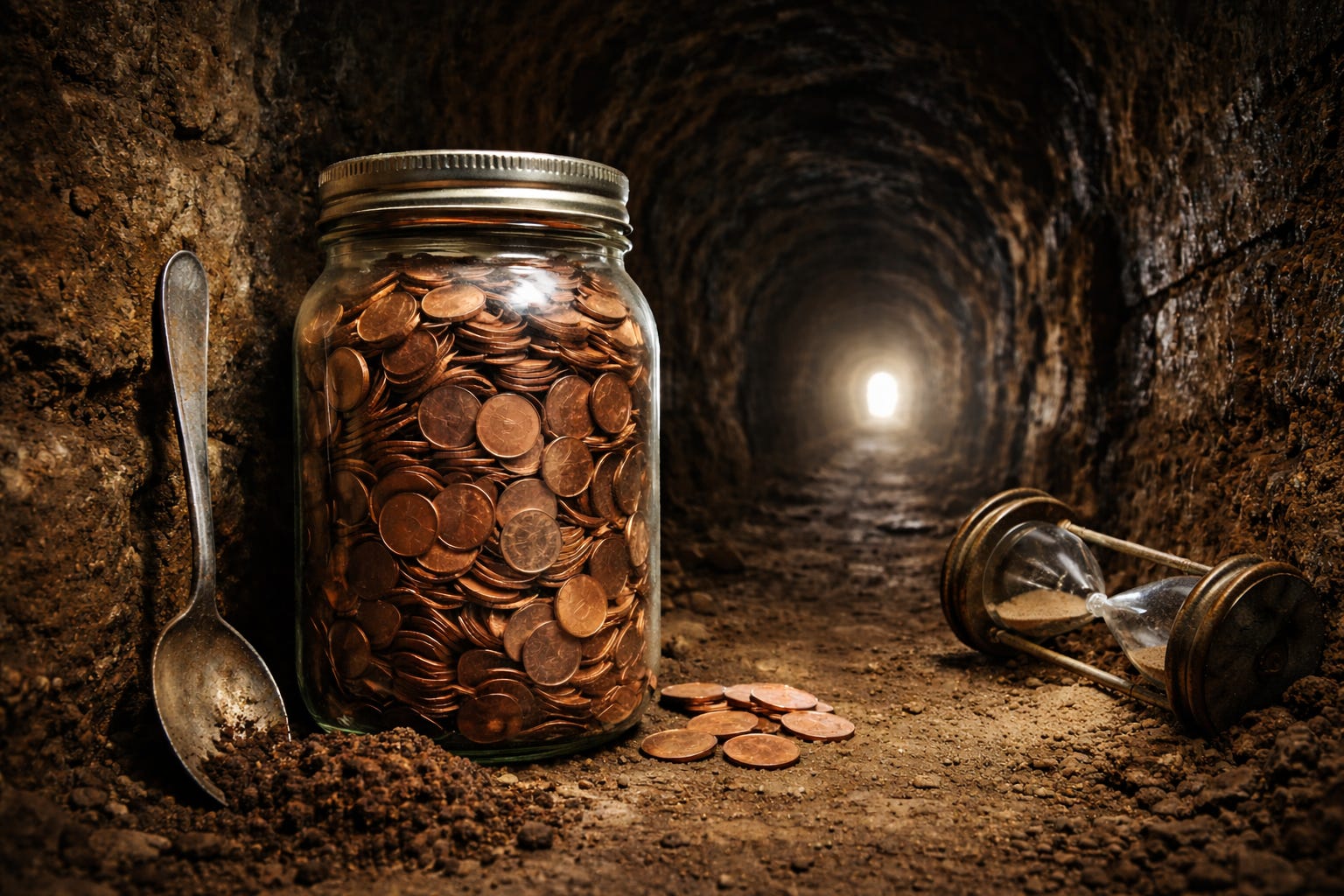
In Alexandre Dumas’s The Count of Monte Cristo, this scene represents more than narrative drama—it offers a philosophy of sustainable progress. Fifteen months of labor with tools fashioned from sharpened cartilage and candlestick knives. Each night, pulverizing stone into powder fine enough to scatter through cell windows, invisible to captors. The tunnel advances through patient accumulation: inches becoming feet, spoonfuls becoming pathways, daily motion becoming eventual liberation.
My grandfather understood this principle in his own way. Walking together through neighborhood streets, he would stop whenever he spotted a penny lying on the sidewalk. He’d point, I’d retrieve it, and he’d say with a grin: “Fortune just smiled at you.” Not for what the coin could purchase—essentially nothing—but for what it represented. Then came the lesson: “This penny needs a friend. And those two will need more friends. You must start somewhere. One penny at a time.”
Years later, I inherited jars of pennies my mother had collected with him before me. Decades of accumulated coins, each worthless in isolation, together representing the principle of beginning, of preserving motion, of honoring the smallest contribution to a larger purpose.
These images—Dantès’s spoon, my grandfather’s penny—followed me as we celebrate the beginning of a new calendar year, that arbitrary marker around which we construct narratives of transformation. The conventional wisdom of New Year’s resolutions—ambitious proclamations affixed to refrigerators, destined for February’s quiet abandonment—operates on a fundamentally flawed premise. We envision radical metamorphosis through sheer declarative force: the sedentary becoming athletic, the spendthrift becoming frugal, mediocre investments becoming exceptional.
The spoon and the penny teach something different about the nature of sustainable progress itself.
The Temporal Paradox of Compounding Effort
Consider the temporal estimation paradox: our systematic tendency to overestimate immediate-term accomplishment while underestimating the cumulative power of sustained incremental effort extended across decades. This cognitive bias pervades human endeavor, but proves most consequential in capital allocation and wealth stewardship.
We imagine transformation through intensity—the concentrated burst of effort, the revolutionary insight, the perfectly timed transaction. Yet empirical reality reveals a different pattern. Like geological processes carving canyons through imperceptible daily erosion, as the Great Wall was constructed over two millennia, lasting financial achievement emerges from persistence.
The first step contains both the entirety of the journey and none of it. Without initial movement, the thousand miles remain theoretical; yet that single step accomplishes nothing measurable. Dantès’s first spoonful represented both everything—the beginning of liberation—and nothing—an invisibly small cavity in an impossibly thick wall. The power resided not in the spoonful itself but in the commitment to a second, a third, the fifteen-thousandth.
The Physics of Motion
Three years ago, a good friend and a fellow investor, Guy Spier, reminded me in a podcast conversation of wisdom often attributed to Confucius: “It does not matter how slowly you move, as long as you do not stop.” Lao Tzu shared: “A journey of a thousand miles begins with a single step.” Together, these aphorisms challenge our understanding of achievement.
A physical analogy illuminates this principle. Many of us have pushed a stalled car at least once—I certainly have. Initial effort proves excruciating—maximum exertion producing minimal displacement. Muscles strain against inertia, feet search for traction, the vehicle seems fused to earth. This phase defeats most aspirations.
But observe what happens when the car begins, finally, to roll. The first inch requires tremendous force. The second, slightly less. By the time momentum develops, you’re jogging alongside, barely touching it, your role transformed from primary mover to gentle guide. The car continues rolling not because you push harder, but because you never allowed it to stop.
This represents the fundamental mechanics of sustainable improvement in any domain—particularly the patient construction of investment excellence.
A Personal Journey Towards Investment Mastery
My own tunnel is a lifelong project to become incrementally more capable as a steward of capital. Not “the best” investor—a meaningless category—but simply better than yesterday, ever learning, ever open to change while holding certain immutable principles carved in stone, and close to my heart.
Each page of a company filing, each earnings transcript, each conversation with practitioners or management, each historical parallel drawn between contemporary dynamics and past cycles—these constitute my spoonfuls of excavated stone. Some days yield genuine insight: a pattern recognized, an opportunity identified, a problem averted. Other days produce merely maintenance: reviewing positions, asking one new question about a long-held company, purchasing or selling a handful of shares to maintain kinetic engagement as my thinking evolves.
The magnitude is irrelevant. What matters is preserving motion itself.
After two decades of managing family fortunes, I observe that investment excellence emerges through the compound accumulation of small, consistent actions. The investor who remains perpetually engaged, even minimally, develops something more valuable than analytical skill: readiness. When opportunity presents itself—rarely when convenient—the investor in motion can respond. The frozen investor cannot act from complete stasis.
This isn’t about catching prey through ambush. It’s about maintaining sufficient motion that when the butterfly crosses your path—both of you in flight—an intersection becomes possible. When circumstances demand action, I’m not starting from immobility but from kinetic readiness.
The Granular Question
Rather than propose ambitious resolutions destined for abandonment, I ask a different question: What constitutes minimum viable progress toward your objective? What is the smallest action that qualifies as genuine movement?
For the writer: perhaps one sentence. For the investor: one page of a filing, five minutes of an earnings call, one share purchased. For the capital accumulator: perhaps not the thousand dollars you wish to save, but the single dollar you can transfer immediately. Magnitude matters less than the directional vector.
The question isn’t “What ambitious goal shall I pursue?” but “What is my spoonful today? My first step?” And more crucially: “What is my second?”
The Secret Fire: Why We Return Tomorrow
Yet we must acknowledge what truly sustains this philosophy of incremental progress across years and decades. The spoonful matters, yes—but only when it serves something transcendent.
Dantès endured fifteen months of nightly excavation not because he loved digging, but because each spoonful participated in a project larger than the immediate act: liberation itself. My grandfather bent to retrieve small coins because each penny participated in teaching a child about the architecture of wealth—how fortunes begin with single units, how compound accumulation transforms the insignificant into the substantial, how starting matters more than starting large.
One afternoon, he came home from the garden carrying an 18th-century copper coin he’d unearthed while turning soil. Oxidized green, barely legible, it sparked a young boy’s imagination: Who had owned it? Who had lost it? That tarnished coin proved the lesson—sometimes spoonfuls of dirt contain genuine treasure.
The secret fire that brings us back tomorrow, and the day after, and ten years hence, burns not from the satisfaction of small tasks completed but from their alignment with purposes that outlast us. Whether we build toward multi-generational family flourishing, construct businesses designed to endure beyond our tenure, or steward capital for descendants not yet born—it is this orientation toward the transcendent that transforms tedious repetition into sacred ritual. The spoonful is the method; the penny needing friends is the philosophy; the purpose beyond ourselves is the fuel.
The Stewardship of Continuous Motion
As we construct new calendar narratives, I propose abandoning the mythology of dramatic transformation for a more modest but infinitely more effective approach—one honoring both Lao Tzu’s first step and Dantès’s persistent spoon.
For myself, the answer remains constant: another page read, another question posed, another day as a perpetual student of markets, businesses, and human behavior. Two decades of practice confirm that if learning never stops, results manifest as a natural consequence. Not because any single day’s education proves decisive, but because accumulated knowledge of ten thousand days creates foundations for judgment no intensive burst could replicate.
This is how tunnels are dug, treasures unearthed, miles traveled, wealth built, and wisdom accumulated. Not through speed, but through philosophical commitment to continued progress. Not through the grandeur of the thousandth mile, but through humility of the next step. Not through drama of breakthrough, but through quiet dignity of the daily spoonful—sustained by clear purpose, by knowing what lies at the end of our tunnel, by understanding that each spoonful serves something larger than the act itself.
One step. One spoonful. One day. Ever closer to a worthy ideal.
Then another.
Before you go…
If this post resonated with you, take a moment, and please share it with anyone in your network who might find it valuable too—this Substack grows entirely through word of mouth from readers like you. Thank you so much!
Disclosure:
Blue Infinitas Capital, LLC is a registered investment adviser. The information presented is for educational purposes only and does not intend to make an offer or solicitation for the sale or purchase of any specific securities, investments, or investment strategies. Investments involve risk and, unless otherwise stated, are not guaranteed. Be sure to first consult with a qualified financial adviser and/or tax professional before implementing any strategy discussed herein. Past performance is not indicative of future performance.